-
 play_arrow
Praise 24/7 NO Today's Best Gospel


Adam Schiff Opposed Trump’s Tax Cuts, Now Backs Hollywood Tax Breaks.
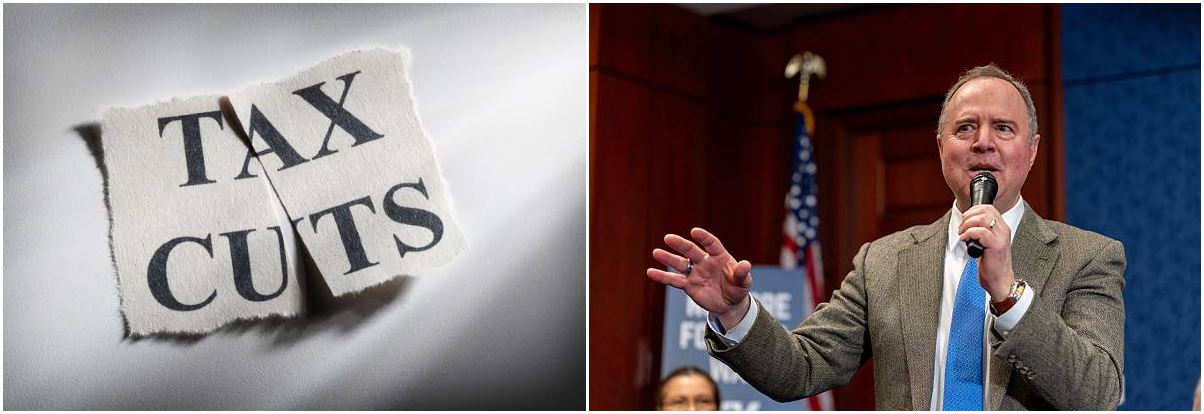
Adam Schiff Opposed Trump’s Tax Cuts, Now Backs Hollywood Tax Breaks.
(ThyBlackMan.com) A family in Ohio has worked hard and sacrificed for three generations to keep their small-town grocery store in business, serving a community they live in and love.
A billionaire in California who invests some of his money in the movie industry lives in a beachside mansion in Malibu.
For which of these two entrepreneurs would Sen. Adam Schiff (D-Calif.) support a tax cut?
It would be the moviemaker.
When the Tax Cuts and Jobs Act came up in Congress in 2017, the Heritage Foundation published a report summarizing what it would do. “The 2017 Tax Cuts and Jobs Act is the most sweeping update to the U.S. tax code in more than 30 years,” said Heritage’s analysis. “The recently released bill would lower taxes on businesses and individuals and unleash higher wages, more jobs, and untold opportunity through a larger and more dynamic economy.”
“The framework lowers rates for almost every tax bracket,” said the analysis. “The current seven brackets remain, but with new generally higher income thresholds and lower rates.”
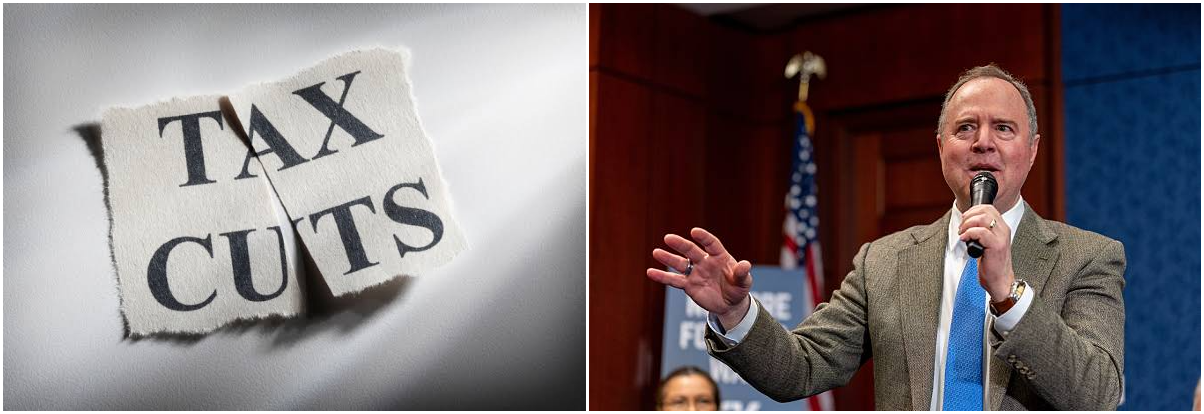
Schiff, who then served in the House of Representatives, was outraged by the proposal.
“I just voted NO on the Republican tax plan,” Schiff said in a 2017 Facebook post.
He argued that he was standing up for the little guy and against increasing the federal debt.
“I support a tax reform that would simplify the tax code and ease the burden on the middle class and small businesses, and one that would be revenue neutral and not increase the deficit,” said Schiff.
“When the GOP started talking about tax reform, they said they wanted to pass a bill that was deficit neutral and wouldn’t add to our national debt, which already exceeds $20 trillion,” Schiff said in the post. “After years of railing against the growing debt, it’s the height of hypocrisy to put forward such an irresponsible bill.”
Despite Schiff’s opposition, the Tax Cuts and Jobs Act became law.
In 2025, the One Big Beautiful Bill Act made permanent the lower tax rates enacted in the Tax Cuts and Jobs Act, which otherwise would have expired at the end of that year. Schiff objected to the tax provisions in this bill also.
A report published by his Senate office criticized the bill for “providing massive tax cuts to President Trump’s millionaire and billionaire friends.”
In fact, federal tax revenues have not declined in the years since the Tax Cuts and Jobs Act was enacted. They have increased.
In fiscal year 2017, the last full fiscal year before the Tax Cuts and Jobs Act was signed into law, total federal revenues were approximately $3.314 trillion, according to the Monthly Treasury Statement. In fiscal 2026, they were $5.403 trillion, according to the Monthly Treasury Statement.
In a speech on the Senate floor on June 30, 2025, Schiff described the tax cuts preserved by the One Big Beautiful Bill Act as a benefit for the wealthiest Americans. “If you are in the top 0.1 percent of income earners, making more than $5 million a year, you will get a $346,000 tax cut,” he said. “How is that fair? How is that right?”
But now Schiff is proposing a tax cut targeted at a very specific group — and they are not poor.
On Sept. 24, he introduced the Motion Picture, Television, and Entertainment Revitalization Act in the Senate. He has been joined in cosponsoring this bill by four Republican senators and four Democrats.
“This bill establishes a federal business tax credit for a percentage of the compensation paid for services performed in the United States related to a qualified film or television production,” says its official summary.
“The bill,” it says, “defines a qualified film or television production as any production that is: a feature film, television pilot, or television season; produced in the ordinary course of business for commercial purposes; capitalized; completed during a tax year with more than $1 million in total costs; and filmed in the United States for 75% of the photography days.”
It also notes that “the tax credit may be transferred to an unrelated third party in exchange for cash.”
Schiff was completely candid in describing this proposal as a subsidy for the movie and television industry.
“For years, Schiff has highlighted the need to increase film production in America and has continued to build bipartisan support in Congress for his federal film incentive proposal,” said a press release published by his Senate office.
“A study published just this week found that the share of production spending by U.S. studios on movies that are made primarily or partially in the U.S. declined from 74 percent to 24 percent over the last quarter century,” said Schiff. “That is a staggering loss in the industry, but this tax credit, which is a base credit of 20 percent, with additional 5 percent credits going up to 30 percent of a tax credit, is layered upon whatever the state of California or other states do. That is powerful enough for the first time to really bring not just TV production back, but film production back, and all the multiplier impacts that has on the economy.”
Finish story here; Adam Schiff Opposed Trump’s Tax Cuts, Now Backs Hollywood Tax Breaks.


-

D.K. Smith
For every Show page the timetable is auomatically generated from the schedule, and you can set automatic carousels of Podcasts, Articles and Charts by simply choosing a category. Curabitur id lacus felis. Sed justo mauris, auctor eget tellus nec, pellentesque varius mauris. Sed eu congue nulla, et tincidunt justo. Aliquam semper faucibus odio id varius. Suspendisse varius laoreet sodales.
close

Post comments (0)