-
 play_arrow
Praise 24/7 NO Today's Best Gospel


9 bell hooks Quotes That Still Speak to Black America.
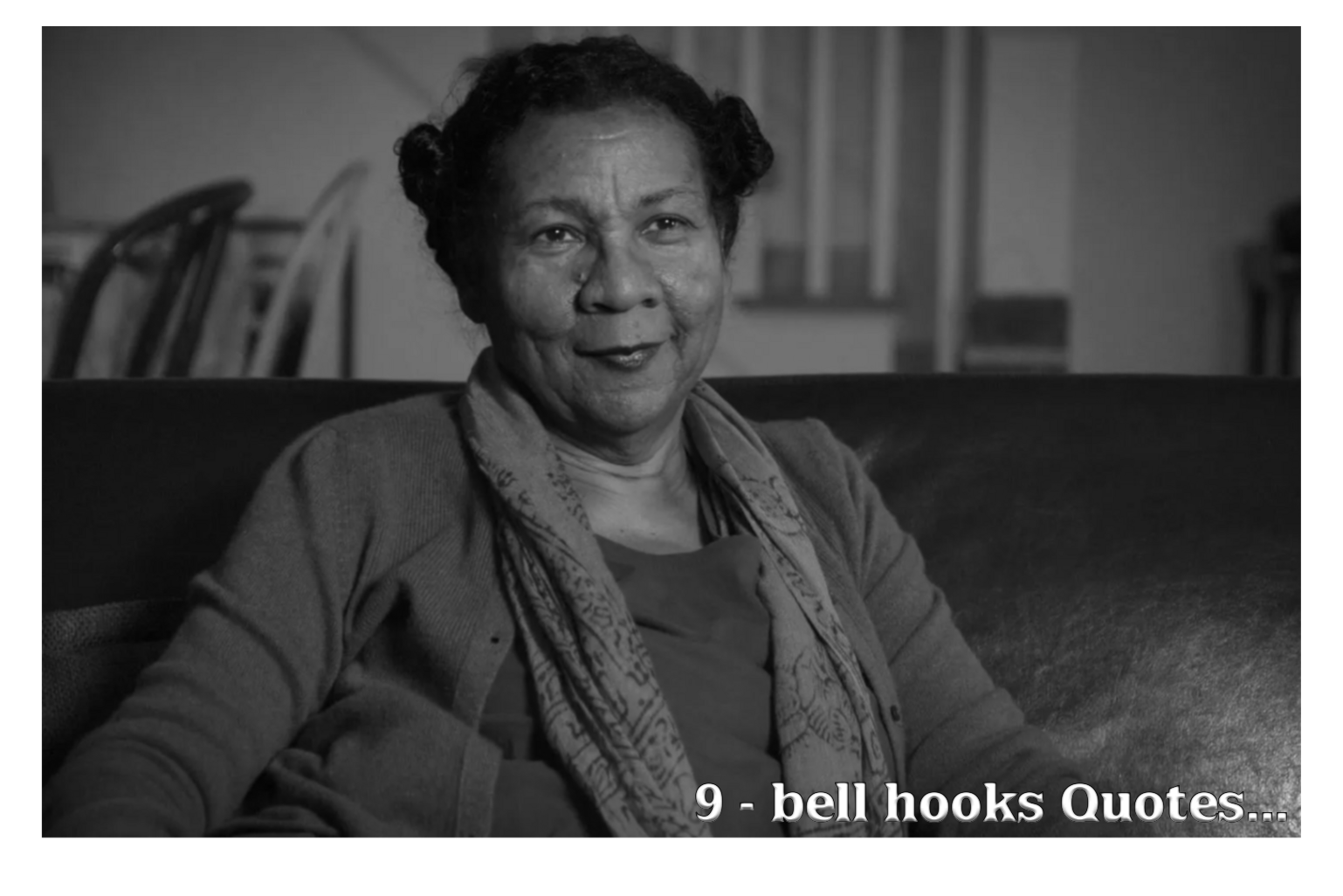
9 bell hooks Quotes That Still Speak to Black America.
(ThyBlackMan.com) Few thinkers spoke to the interior life of Black America with the clarity, compassion, and insistence of bell hooks. Her work never asked readers to perform enlightenment. It asked them to be honest. Honest about pain. Honest about love. Honest about power. Honest about responsibility.
bell hooks understood that liberation was not just a political project, but a deeply personal one. Her writing bridged feminism, race, class, love, and healing in a way that felt less like theory and more like conversation. She spoke directly to Black women without erasing Black men. She critiqued systems without dismissing the humanity of the people trapped inside them.
The following nine quotes are not just memorable lines pulled from interviews or books. They are entry points. Each one opens a door into a larger conversation that still matters deeply today. These are words meant to be revisited, argued with, sat beside, and carried forward.

1. “Until the legacy of remembered and reenacted trauma is taken seriously, Black America cannot heal.”
What bell hooks was naming here is something many communities feel but struggle to articulate: trauma is not only something that happens to people, it is something people learn to live inside of. When trauma goes unnamed, it becomes normalized. Children grow up absorbing tension, fear, and emotional restraint without ever being told why those patterns exist. Over time, survival becomes mistaken for wellness.
Historically, Black America was never granted the luxury of collective mourning. From slavery to Jim Crow to modern state violence, loss followed loss with little space to grieve publicly or privately. bell hooks understood that when grief is postponed indefinitely, it mutates into anger, numbness, and despair. This unresolved pain often turns inward, fracturing families and communities rather than the systems that caused the harm.
This quote also challenges respectability narratives that pressure Black people to appear “over it.” The expectation to be endlessly resilient, productive, and composed leaves no room for emotional reckoning. bell hooks rejected the idea that progress meant silence about suffering. She insisted that healing requires confronting the past honestly, even when that truth is uncomfortable or disruptive.
By emphasizing reenacted trauma, bell hooks pointed to patterns that repeat themselves across generations: harsh parenting rooted in fear, emotional distance mistaken for strength, and mistrust framed as wisdom. Healing, in her view, means interrupting those patterns. It means learning new ways to relate, protect, and care for one another without denying history.
2. “Since loving is about knowing, we have more meaningful love relationships when we know each other and it takes time to know each other.”
bell hooks’ definition of love stood in sharp contrast to romantic myths that prioritize intensity over understanding. She argued that passion without knowledge is unstable, and affection without accountability often leads to harm. To love someone is to commit to learning who they are, not who we want them to be.
This quote also critiques power dynamics within relationships. When people do not truly know one another, assumptions fill the gap. Those assumptions are often shaped by gender roles, cultural expectations, and unresolved trauma. bell hooks believed that knowing someone requires listening without the intent to control or correct. It requires curiosity rather than possession.
In Black communities, where love has often been shaped by external pressures like racism, economic stress, and social surveillance, relationships can become sites of both refuge and strain. bell hooks recognized that many people were taught to equate love with endurance rather than understanding. Her work invited readers to unlearn that lesson.
The emphasis on time is especially important. bell hooks rejected the idea that love could be rushed into existence. Trust develops slowly. Intimacy deepens through consistency. In a culture that rewards speed and performance, this message serves as a reminder that meaningful connection cannot be automated or optimized.
3. “In this culture, the phrase ‘Black woman’ is not synonymous with ‘tender,’ or ‘gentle.’ It’s as if those words couldn’t possibly speak to the reality of Black females.”
bell hooks identified this cultural erasure as both historical and ongoing. From slavery onward, Black women were cast as laboring bodies rather than feeling beings. That legacy continues in media representations that emphasize strength while ignoring vulnerability. The result is a narrow image that denies Black women their full humanity.
This stereotype does not only come from outside the community. bell hooks acknowledged that internalized expectations often pressure Black women to suppress their own needs in the name of survival or loyalty. Tenderness becomes something to give, not something to receive. Gentleness is postponed until some undefined future moment that never arrives.
The consequences are profound. Emotional suppression manifests physically and psychologically. bell hooks linked this denial of softness to stress-related illness, burnout, and relational exhaustion. When tenderness is treated as a luxury rather than a necessity, care becomes conditional instead of foundational.
By naming this imbalance, bell hooks offered permission. Permission for Black women to rest. To feel deeply. To be protected rather than always protecting. Her insistence on tenderness was not sentimental. It was political. Reclaiming gentleness disrupts a culture that profits from Black women’s depletion.
4. “I think the number one thing Black women and all Black people should be paying attention to is our health.”
bell hooks viewed health as a measure of freedom. A community constantly operating in survival mode cannot sustain long-term liberation. She understood that physical illness, emotional distress, and psychological fatigue are not personal shortcomings but responses to prolonged exposure to stress and inequality.
This quote challenges the idea that sacrifice is always noble. bell hooks questioned narratives that celebrate self-neglect as strength. Working through pain, ignoring exhaustion, and minimizing emotional distress may keep systems running, but they erode individuals over time. Health, she argued, must be protected deliberately.
She also expanded the definition of health beyond doctor visits and diagnoses. Emotional honesty, meaningful relationships, rest, and creative expression were all part of her vision of wellness. bell hooks believed that healing required cultural change, not just individual effort.
Today, this quote resonates as more people acknowledge the cost of constant vigilance. bell hooks reminds readers that caring for the body and mind is not a retreat from justice work. It is what allows that work to continue without destroying the people doing it.
5. “I think the Women’s movement has had a major impact on everybody’s lives in our nation and in the world as a whole.”
bell hooks recognized that even people who reject feminism have benefited from its victories. Workplace protections, expanded educational opportunities, shifts in family roles, and the normalization of women’s voices in public life are all outcomes of feminist struggle. This quote acknowledges that feminism altered the social landscape in ways so embedded that they are often taken for granted.
She was especially attentive to how feminism reshaped private life. bell hooks argued that the movement challenged the assumption that caregiving was exclusively women’s work and that emotional expression was a female weakness. By questioning those norms, feminism created space for men to experience vulnerability without shame and for children to grow up witnessing more balanced models of partnership.
At the same time, bell hooks was clear-eyed about feminism’s failures. She consistently warned that movements centered on white, middle-class women often treated race and class as secondary concerns. When feminism ignores the lived realities of poor women, Black women, and women outside the West, it risks reinforcing the very systems it claims to oppose.
This quote remains relevant because feminist movements continue to wrestle with inclusion and accountability. bell hooks reminds readers that impact alone is not enough. The question is not whether feminism changed the world, but for whom those changes truly worked.
6. “I get so tired of people acting like, you know, Black men and women never help each other, never support each other.”
bell hooks spoke from frustration born of observation. She knew the narrative of perpetual conflict between Black men and women was both false and corrosive. It erased generations of shared labor, resistance, and care that sustained Black communities under immense pressure.
Historically, Black survival depended on cooperation. Families functioned as economic units. Churches served as organizing centers. Civil rights movements were built through collaboration, not competition. bell hooks understood that highlighting only moments of tension distorted this reality and weakened collective memory.
She also recognized how these divisive narratives serve external interests. When Black men and women are framed as adversaries, attention shifts away from structural forces that exploit both. bell hooks challenged readers to question who benefits from these portrayals and why they persist.
Her call was not for silence around harm or imbalance. bell hooks believed in critique grounded in love, not contempt. Accountability and solidarity were not opposites in her worldview. They were complementary tools for healing and growth.
7. “Class is more than money. Class is also about knowledge.”
bell hooks’ insight into class cuts against the idea that economic success alone equals liberation. She argued that knowledge shapes how people move through institutions, understand power, and imagine possibility. Without access to critical knowledge, material gains can still leave individuals vulnerable.
This quote speaks to the invisible barriers people encounter even after financial advancement. Knowing how systems operate, how language is used to exclude, and how history informs the present determines who feels entitled to speak and who remains silent. bell hooks understood that ignorance is often manufactured and enforced.
In many communities, access to knowledge is constrained by underfunded schools, limited libraries, and cultural messaging that discourages intellectual curiosity. bell hooks saw education not as credentialing, but as consciousness-building. Knowledge equips people to question narratives rather than absorb them uncritically.
Her perspective urges a broader vision of justice. Economic redistribution matters, but so does intellectual empowerment. bell hooks believed that true freedom requires both.
8. “Certainly we can end racism with love. We can demand that the federal government change its emphasis on racial distinction.”
bell hooks’ invocation of love was never naive. She defined love as a commitment to justice, truth, and accountability. In this quote, love is not passive acceptance, but a force that motivates political engagement and structural reform.
She challenged the assumption that emotional language weakened political demands. bell hooks argued that love sustains movements by preventing burnout and dehumanization. Without love, resistance risks mirroring the cruelty it seeks to dismantle.
At the same time, she rejected symbolic gestures without substance. Calling for love without policy change was, in her view, an empty performance. bell hooks insisted that compassion must be paired with demands for institutional accountability, particularly at the level of government.
This balance remains difficult and necessary. bell hooks offers a framework that allows for anger without hatred, resistance without nihilism, and hope without denial.
9. “Until the legacy of remembered and reenacted trauma is taken seriously, Black America cannot heal.”
Ending with this quote underscores its role as a throughline in bell hooks’ thinking. Trauma, she argued, shapes how people love, organize, and imagine the future. Ignoring it ensures that progress remains fragile and incomplete.
Repetition here is intentional. bell hooks understood that trauma repeats when unaddressed, manifesting in behavior, belief, and structure. By restating this truth, she emphasized its urgency rather than diminishing its power.
In the present cultural moment, where historical reckoning competes with calls to “move on,” this quote functions as a warning. Healing cannot be rushed or legislated away. It requires sustained attention, honesty, and care across generations.
bell hooks leaves readers with a moral obligation. Healing is not abstract work. It happens in families, classrooms, policies, and daily interactions. To take trauma seriously is to commit to transformation that is slow, collective, and enduring.
bell hooks’ words continue to matter because they demand honesty. They ask readers to confront trauma rather than outrun it, to practice love rather than perform it, and to understand justice as something lived, not merely discussed. These quotes are not reminders of the past. They are tools for the present.
To take bell hooks seriously is to accept responsibility for healing, for community, and for change. Her work makes one thing clear: liberation is not automatic. It is intentional, ongoing, and deeply human.

-

Praise 24/7 Commercial Free
For every Show page the timetable is auomatically generated from the schedule, and you can set automatic carousels of Podcasts, Articles and Charts by simply choosing a category. Curabitur id lacus felis. Sed justo mauris, auctor eget tellus nec, pellentesque varius mauris. Sed eu congue nulla, et tincidunt justo. Aliquam semper faucibus odio id varius. Suspendisse varius laoreet sodales.
close

Post comments (0)