-
 play_arrow
Praise 24/7 NO Today's Best Gospel


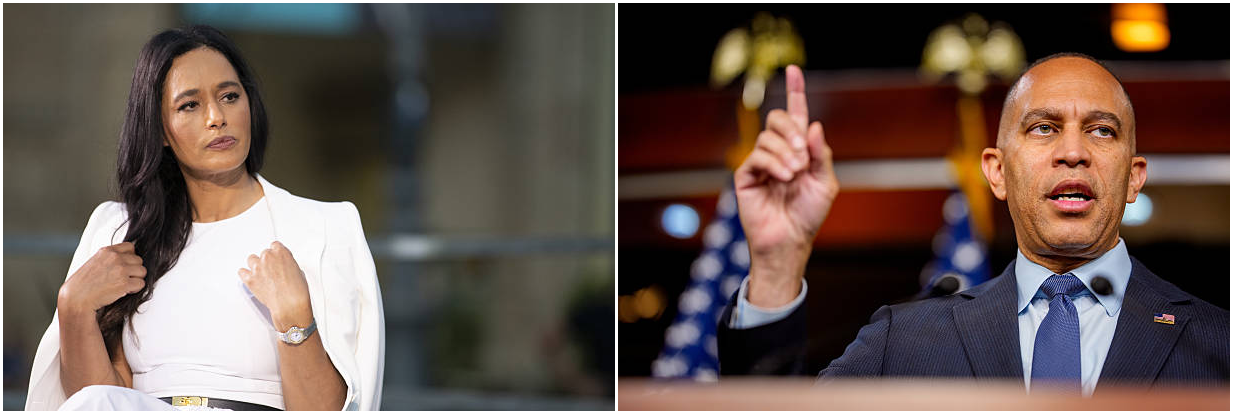
Rula Jebreal Faces Backlash Over Hakeem Jeffries “AIPAC Monkey” Remark.
Rula Jebreal Faces Backlash Over Hakeem Jeffries “AIPAC Monkey” Remark.
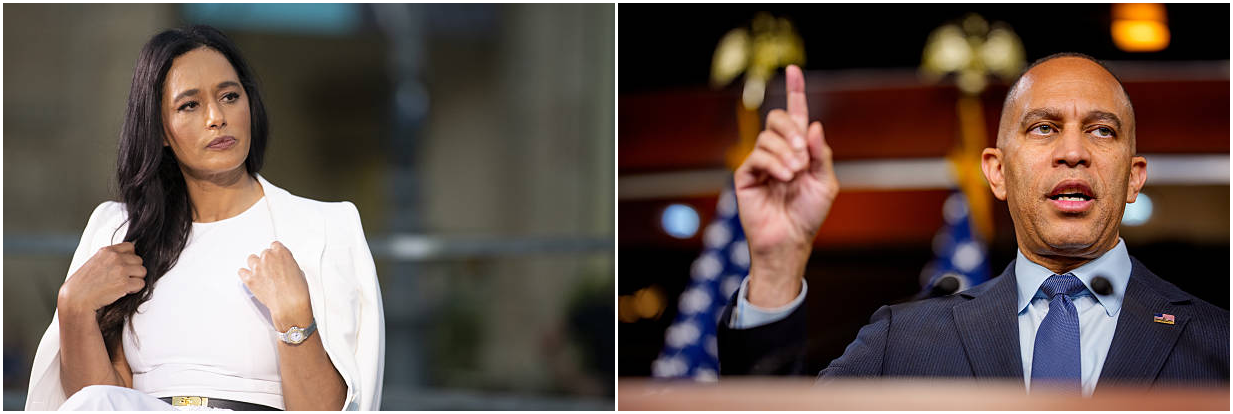
(ThyBlackMan.com) So here is the mess that dropped this week, and I aim to give it to you plain. Journalist Rula Jebreal went on The Left Hook podcast with host Wajahat Ali and called Hakeem Jeffries an “AIPAC monkey.” Then she piled on with “errand boy.” Right after that came the line people keep quoting. “With all due respect, and I don’t mean it in a racist way.” The remarks quickly drew condemnation from the Congressional Black Caucus and several Democratic lawmakers.
Sit with the arithmetic of that sentence for a second. You reach for an insult with an ugly and well-documented history when aimed at Black people, you pin it on the first Black lawmaker ever to lead a major political party in Congress, and then you ask the room to believe race had nothing to do with it. Afterward Jebreal explained that she had the three wise monkeys in mind, the familiar see no evil, hear no evil, speak no evil image. That explanation did not stop the backlash.
Hold on though. I won’t have a soul in here twisting my meaning. Hakeem Jeffries is not above criticism. Not even close. Question his relationship with AIPAC. Question his posture toward Israel amid Gaza’s continuing humanitarian crisis and severe food insecurity. Argue over whether Democratic leadership has been too cautious or too accommodating. All of that belongs in the rough business we call politics. Current humanitarian assessments project that roughly 1.4 million people in Gaza will face Crisis level or worse acute food insecurity between July and December 2026.
But there sits a canyon between attacking a man’s votes and reaching for language historically used to diminish Black humanity. One is political debate. The other carries baggage that generations of Black Americans have had to recognize and confront.
That particular comparison carries a history no clever explanation can simply wash away. American popular culture spent generations portraying Black people as primitive, animalistic, intellectually inferior, and even apelike. The Jim Crow Museum documents postcards, advertisements, cartoons, and other objects that explicitly linked African Americans with monkeys and apes. The Smithsonian likewise documents racist caricatures that helped reinforce social and political stereotypes about Black Americans. Drag that imagery into a political argument involving a Black man and the history comes with it whether the speaker intended every part of that history or not.
Here comes the part that ought to trouble every honest reader. Standards against racist language mean very little if they change depending on who says the words. Political affiliation does not erase history, and ideological agreement does not make dehumanizing language harmless.
So the question is not whether the speaker belongs to the right or the left. The question is whether people are willing to apply the same standard when the offensive language comes from somebody whose politics they otherwise share.
Ritchie Torres put that consistency question directly into the public conversation. The New York Democrat argued that if Jebreal and Ali had been figures on the far right, critics on the far left would have had little difficulty condemning the language. He finished by saying, “The silence is deafening.” Torres was among several Democratic lawmakers who publicly condemned the remarks.
I have watched this shuffle my entire life, in church business and union halls and city council chambers. People decide first who they are loyal to, then they decide what they are willing to see. Loyalty can slide on like a pair of blinders. Once that happens, another person’s dignity can become negotiable, depending on who happened to throw the punch. That temptation is hardly unique to one political party or ideology.
Let me say a thing that may sting a few readers. Bigotry does not check voter registration before it lands. Racist language does not become harmless because the person delivering it shares somebody’s views about healthcare, housing, Israel, Palestine, taxes, or anything else. The history attached to anti-Black imagery remains there regardless of the speaker’s political affiliation.
The Congressional Black Caucus said much the same thing in its response. The caucus rejected Jebreal’s explanation and said there was no “non-racist way” to call Jeffries, a Black man, a monkey or errand boy. It also called for rejecting anti-Black racism whether it comes from the political right or left.
Other Democrats spoke publicly as well. Torres condemned the remarks, and Representatives Joe Neguse and Ayanna Pressley were among the lawmakers reported as criticizing Jebreal’s language. That matters because the most credible standard is one applied without checking first whether the offender is a political friend or enemy.
Because that is the real test, is it not. It is easy to recognize offensive language when it comes from somebody you already distrust. The harder test comes when the speaker shares your causes, attends your gatherings, or agrees with you on nearly everything else. Consistency means the rule survives that test.
I will be fair about the apology too, because the record matters. Jebreal reiterated her criticism of Jeffries and AIPAC before acknowledging that the term she used was inappropriate, offensive, and should never have been used. She then ended her statement plainly: “I apologize unconditionally.” Readers can decide for themselves whether restating the underlying political grievance weakened the apology, but it would be inaccurate to say she never offered an unconditional one. She did.
Young brothers, hear me now. Do not let anybody sell you the notion that your dignity depends on the ideology of whoever is speaking about you. Nobody should be expected to excuse racially loaded language merely because it comes from somebody whose politics they otherwise support. That standard should travel in every direction.
Criticize Hakeem Jeffries. Criticize his votes, donors, leadership decisions, foreign policy positions, or anything else he does in public office. That is part of citizenship, and elected officials should expect vigorous scrutiny. But political disagreement does not require reaching for imagery that has historically been used to portray Black people as less intelligent, less civilized, or less human.
A racial insult does not lose its history because the speaker stands on one side of the political aisle rather than the other. The harder and more useful principle is simpler than that. Judge the language by the same standard every time, no matter who says it and no matter whose politics happen to be under attack.
Staff Writer; L.L. McKenna
Politics explained through the lens of justice and equity. Offering perspective that informs, challenges, and empowers.
One can contact this brother at; LLMcKenna@ThyBlackMan.com.




Post comments (0)